Sleep Basics · Crib Safety
A Safer Sleep Surface: What to Know About Organic Crib Construction
A crib mattress can be described with appealing words—organic, natural, breathable, gentle. But when you are preparing a sleep space for a baby, the most important questions are more practical: Does the mattress fit the crib? Is its surface firm and flat? What do its materials and certifications actually tell you? Here is how to look beyond the label while keeping safe-sleep guidance firmly in view.
Published November 3, 2026
Choosing a crib mattress can feel like a small decision carrying an outsized emotional weight. New caregivers are often sorting through advice, product descriptions, family recommendations and a steady stream of claims about what makes a sleep surface healthier or more comfortable. An organic label may be one factor in that search, but it does not replace the basic requirements of a safe sleep setup.
Construction matters because a crib mattress is more than its outer fabric. Its core, cover, seams, dimensions and fit all contribute to how it works in the crib. At the same time, no material descriptor—organic cotton, wool, foam or otherwise—can establish on its own that a particular sleep arrangement is safe for an infant. The useful approach is to check the mattress against current safety guidance first, then consider materials, certifications and care as additional information.
Start with fit, firmness and a flat surface
Before comparing fibers or reading a long list of construction details, confirm that the mattress is designed for the specific crib. It should fit snugly within the crib without large gaps at the sides. Check the crib and mattress instructions, including the dimensions and any manufacturer guidance about compatible mattress sizes. A mattress that appears close to the right size is not enough; the fit needs to be appropriate for that crib.
The sleep surface should also be firm and flat, with a fitted sheet that is made for the mattress and stays securely in place. Firmness is not the same as an adult’s idea of plush comfort. A surface that feels soft, deeply cushioned or enveloping is not a reason to add it to an infant’s sleep space. Follow current recommendations from recognized pediatric health and public-health authorities, and consult your child’s clinician if you have questions about an individual medical situation.
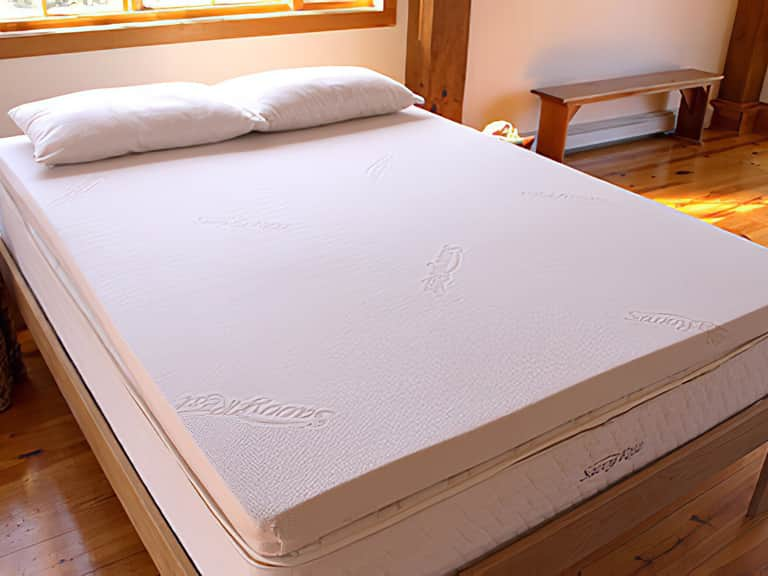
Keep the crib clear of extra padding and soft objects. That means no mattress toppers, quilts, pillows, loose blankets, positioners or other added cushioning in the sleep space. A separate layer can change the surface’s firmness, create gaps or shift during use. Even if an accessory is described as breathable, organic or specifically made for comfort, those words do not make it an appropriate addition to an infant’s crib.
- Choose a mattress intended for the exact crib or crib size, and check the fit according to the manufacturers’ instructions.
- Use a firm, flat mattress with a snugly fitted sheet designed for that mattress.
- Do not add toppers, pads, wedges or other cushioning to the infant sleep surface.
- Keep soft items and loose bedding out of the crib, and follow current safe-sleep advice.
What “organic” can—and cannot—tell you
“Organic” often refers to how a particular agricultural fiber was grown and processed under a defined standard. It does not automatically describe every part of a finished mattress, establish that all components are organic, or prove that a product is safer for every baby. A mattress may contain several materials, and its cover, filling, core and finishing treatments can have different origins and certifications.
Read the full materials description rather than stopping at the largest type on a label. Look for a component-by-component account: What is the cover made from? What is inside it? What forms the support core? Are there adhesives, coatings or other treatments? If those details are missing or unclear, the word “organic” alone will not fill in the gaps. Contact the manufacturer for specifics when they matter to your decision.
Natural materials are not automatically free of allergens, and synthetic materials are not automatically unsafe. A baby’s individual sensitivities, the way an item is made and maintained, and the suitability of the product for infant sleep are separate considerations. For concerns involving allergies, asthma, skin conditions or other health needs, ask a pediatric healthcare professional rather than relying on broad marketing claims.
Cotton, wool and other common components
Cotton is commonly used in mattress covers and textile layers. Depending on its weave and construction, it can feel smooth, crisp or quilted. If the cotton is certified organic, that certification may provide information about the fiber’s production under the certifier’s standard. It does not, by itself, tell you whether the mattress fits the crib, whether its surface is firm enough, or whether the complete product meets applicable requirements.
Wool may appear as a filling or in a layered construction. Product descriptions may discuss its ability to manage moisture or provide insulation, but those properties do not change the safe-sleep basics. Wool content is also not a substitute for checking the full construction or the manufacturer’s care instructions. As with any material, families should look at the specific product information and consider individual sensitivities.
Some mattresses include foam or other core materials designed to provide structural support. The terms used to describe a core can vary, so it is worth checking what the manufacturer means by “firm,” “supportive” or “breathable.” A marketing phrase is not a measurement or a guarantee. The mattress still needs to be intended for infant use, used as directed and appropriate for the crib in which it will be placed.
There is no need to treat one fiber as a universal solution. The sleep surface’s essential job is to be a correctly fitting, firm, flat surface used in accordance with safety guidance. Material preferences can come afterward, informed by clear documentation, practical care needs and a realistic understanding of what product claims establish.
How to read certifications without overreading them
Certifications can make a complicated materials story easier to investigate, but they have defined scopes. A certification may apply to a textile, a processing stage, a facility or particular substances. It may not cover every component of the finished mattress. Check the certificate or certifier’s own explanation, and verify that the product or specific material is covered rather than assuming a logo applies to the entire sleep system.
It helps to ask three questions: What exactly is certified? Which standard does the certification refer to? Is the claim current and verifiable? A manufacturer should be able to explain what a label means and identify which parts of the product it covers. If a claim is vague, a request for documentation can help distinguish a meaningful certification from an impression created by attractive wording.
Certification is useful information, not a substitute for infant-sleep safety requirements or a promise of a particular health outcome. A certified fabric does not automatically make a mattress compatible with every crib. Nor does a materials certification establish that a mattress is firm and flat. Keep those questions separate as you compare options.
Construction details worth checking
A careful review starts with the product’s intended use. Confirm that it is specifically designed as a crib mattress for the relevant crib type and size. Then read the maker’s instructions about installation, compatible sheets, cleaning, rotation if applicable, and when the mattress should be replaced. Do not rely on general advice for adult mattresses when the product is intended for an infant.
Pay attention to the cover and seams as well as the core. Look for clear instructions on whether the cover is removable, how it should be cleaned and whether the product must be kept dry. Do not remove or alter components unless the manufacturer specifically instructs you to do so. A cover that can be washed may be convenient, but a removable layer should never be treated as an invitation to add another pad or cushion.
Inspect the mattress when setting it up and periodically during use. Follow the manufacturer’s instructions if you notice damage, a compromised cover, unusual deterioration or a change that affects the fit. If a mattress no longer sits correctly in the crib or its condition raises concerns, stop using it until you can resolve the issue with the manufacturer or another appropriate source.
A practical checklist for caregivers
When product pages begin to blur together, a short checklist can help bring the decision back to what is verifiable. Keep safety and fit at the top, then use material and certification details to answer secondary questions.
- Intended use: Is it clearly identified as a crib mattress for infant use?
- Compatibility: Does the manufacturer identify it as suitable for the crib’s size and type?
- Fit: Does it fit snugly according to the crib and mattress instructions?
- Surface: Is it designed to provide a firm, flat sleep surface?
- Materials: Are the cover, filling and core described separately and clearly?
- Claims: Do “organic,” “natural” or “low chemical” claims identify what they apply to?
- Certification: Can you verify the standard and the specific component or product covered?
- Care: Are cleaning, drying and maintenance directions easy to find?
- Sleep setup: Can you use the mattress with only a fitted sheet, without adding padding?
Why toppers and extra pads deserve special caution
Mattress toppers and comfort pads are familiar accessories in adult bedding, where people may use them to alter softness or add cushioning. An infant crib is different. A topper changes the surface that the mattress was designed to provide and can introduce a new layer that shifts, bunches or creates an unsuitable sleep environment. For that reason, caregivers should not add a topper or extra padding to make a crib mattress feel softer or more comfortable.
The same caution applies when an accessory is marketed as organic, washable or moisture-managing. Those descriptions do not establish that it is appropriate for use on an infant’s sleep surface. Use only the mattress and fitted sheet as directed, and check current safe-sleep recommendations if you are uncertain about an item’s role.
A calm, evidence-aware way to decide
It is understandable to want a sleep space that feels clean, comfortable and thoughtfully made. But the search does not need to become a contest in which every material claim has to be solved before you can choose. Separate what is essential from what is a preference: first confirm intended use, fit, firmness and a flat surface; then examine construction, care information and any certification that matters to your family.
Be cautious of claims that promise better sleep, superior health or complete protection based solely on a material name. No single fiber or label can make those guarantees. A clear product description, accessible safety information and straightforward care directions are more useful than sweeping promises. When evidence or product details are incomplete, it is reasonable to ask for clarification or choose an option with information you can verify.
For the latest guidance, consult recognized pediatric and public-health sources, and speak with your child’s healthcare professional about questions specific to your baby. Recommendations can be updated as evidence develops, so a saved checklist or familiar product description should not take the place of current advice.
The bottom line
An organic crib sleep surface is best assessed through two lenses: what it is made of and how it functions in the crib. Cotton, wool and other materials may be part of a thoughtfully documented construction, while certifications can clarify certain production or material claims. Neither replaces the essentials: a properly fitting crib mattress, a firm and flat surface, a snug fitted sheet and no added toppers or padding.
When caregivers keep those priorities in order, the details become easier to evaluate. Read labels closely, verify what certifications cover, follow the manufacturer’s care instructions and keep the crib free of extra soft items. A simple, correctly set up sleep surface is a more meaningful starting point than any single word on a product label.